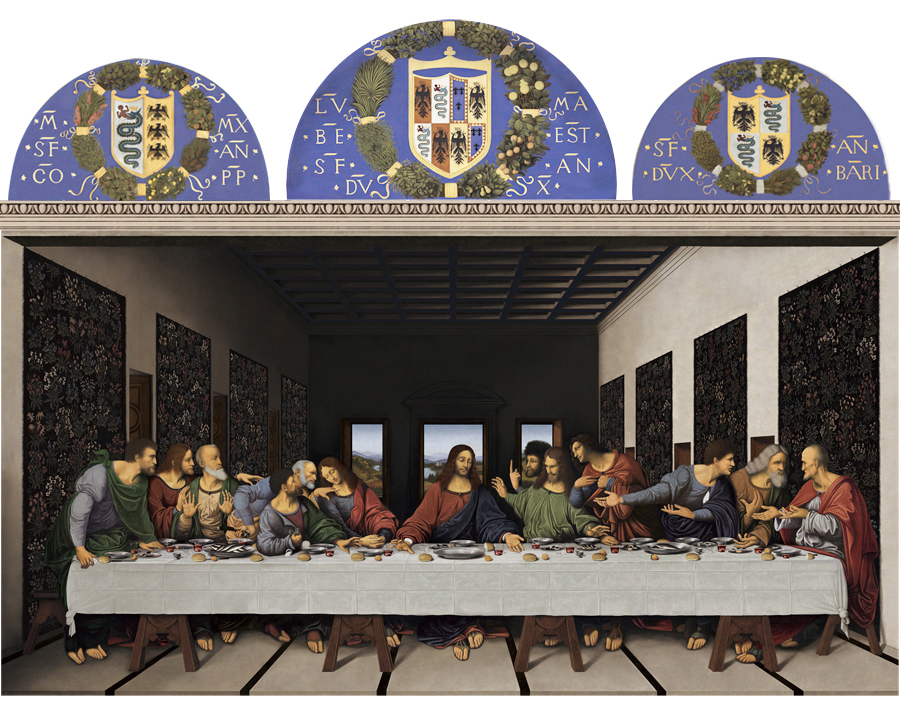
My The Last Supper
It has already been 30 years since I first visited the Last Supper in Milan.
At that time, the Last Supper was under restoration, and the restoration that started with Simon had just reached Jesus near the center of the screen.
In front of the large mural, a stage was set up to the height of the table depicted on the screen, and on top of it was a small scaffolding where people could sit and work. Furthermore, the entire staircase and scaffolding leading up to the stage is covered with white cloth, making the lower half of the screen completely invisible.
To be honest, I remember being quite disappointed as the condition of the mural was quite poor, which I had expected. Particularly bad was the unrepaired left half of the screen, which was so dark that it was difficult to see what was being drawn.
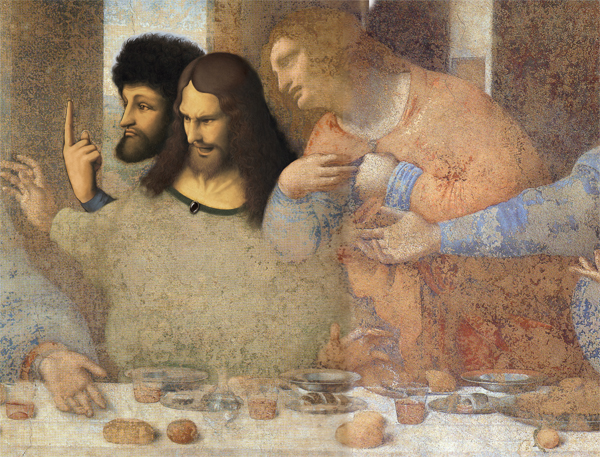 Left figure: Reconstruction of Thomas and Jacob the Greater
Restoring the facial expressions of Thomas and Jacob the Greater is the most nerve-wracking task.
This is because it is one of the important elements that influences the image of the Last Supper.
It is especially difficult to depict Thomas' facial expressions, and in many reproductions he is often depicted as looking like a monkey.
Digital era
Shortly after returning from a trip to Italy, I acquired new art supplies that were completely different from the ones I was used to. A personal computer.
Although I had known about its existence for some time, it was not yet widely available and I had never used it before.
When you actually use it, its innovativeness makes you realize that it has a lot of possibilities, and its convenience is especially outstanding when trying out various variations.
Additionally, even simple tasks such as comparing images used to require the use of multiple equipment such as copying, printing, and preparing light boxes, but now all of these tasks can be completed using just a computer. has made significant progress in improving efficiency.
The spread of personal computers became the impetus for the restoration of the Last Supper.
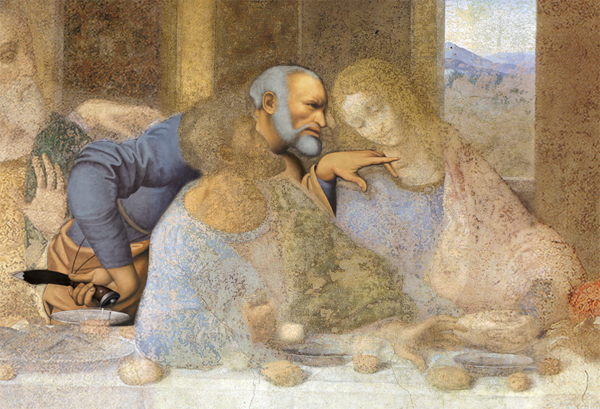 Left figure: Restoration of Matthew
In Leonardo's time, there was a tendency to be able to use foreshortening and draw figures from difficult angles as a sign of being a great painter.
Leonardo was also good at this shortening method and often used it when drawing people.
In addition to Matthew, the Last Supper is also depicted using these techniques.
The Last Supper facts
When we actually started the restoration of the Last Supper, we discovered that the original mural was surprisingly lacking in authenticity.
If you look at the enlarged image of the details, you can see that many parts have been filled in by the conservator, and very little of the parts drawn by Leonardo remain. If you remove the conservator's additions to a person's facial expressions, it becomes impossible to tell what was actually drawn.
In addition, many questions arise when comparing the parts added by this conservator with the reproductions of the Last Supper painted in Leonardo's time.
After all, the reality is that as it stands, there is almost no reliable part of the Last Supper.
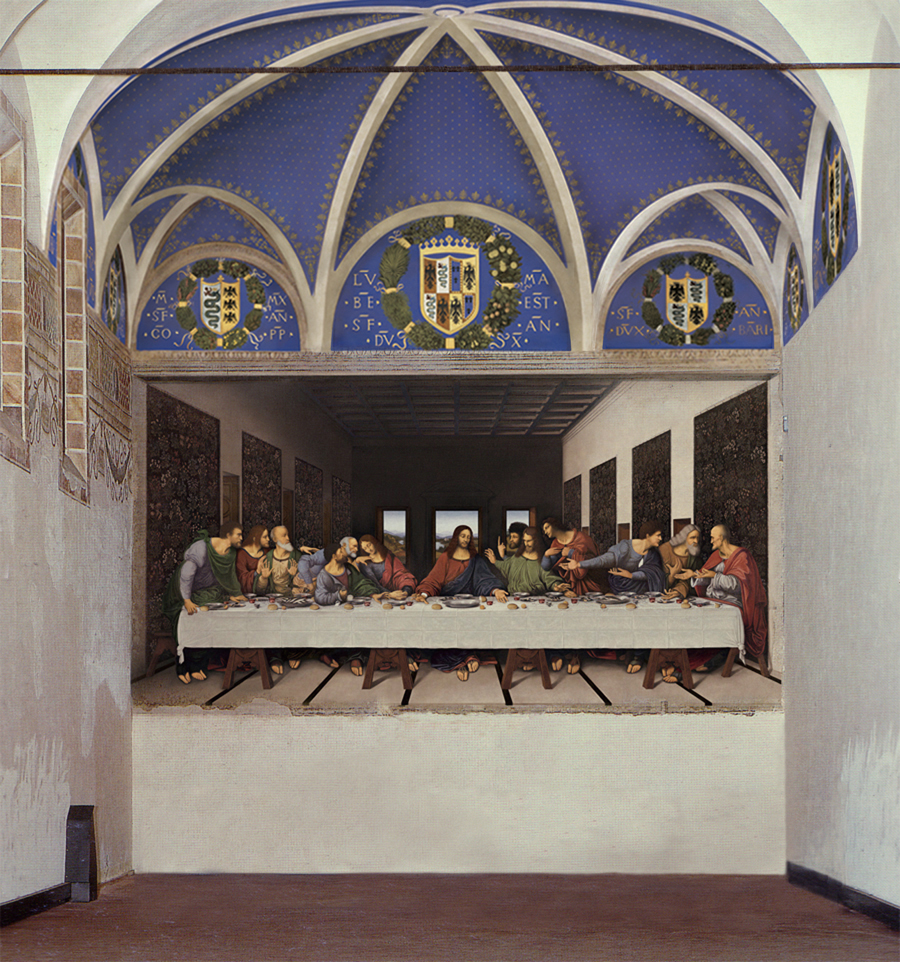
The Last Supper of Leonardo
The image below is a drawing that Leonardo prepared for the Last Supper.
At first glance, it appears to be just a simple concept at an early stage, but I believe that this small drawing was the final blueprint for the Last Supper. The reason is that the pose of the person on the right side of the completed Last Supper screen almost matches that of the person depicted in this drawing.
The following steps seem to be how Leonardo proceeded to create the mural based on this drawing.
 ①Leonardo's original drawing.
Leonardo draws on the bottom of the page, folding back the parts where there is not enough space.
From this we can see that Leonardo drew this sketch from right to left.
The important points in this drawing are that John and Peter are depicted on either side of Jesus in the center of the painting, and the other point is that Judas is depicted alone on the opposite side of the table.
This style has traditionally been used to depict the Last Supper, and the Last Supper before Leonardo was generally painted with this composition.
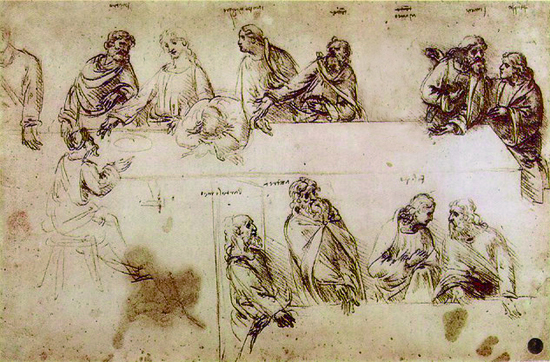 ② Image with the third person from the right removed from the screen.
Leonardo probably didn't like the pose of the third person from the right, so he removed this person from the Last Supper.
The image below is then drawn by filling the empty space with the person next to it.
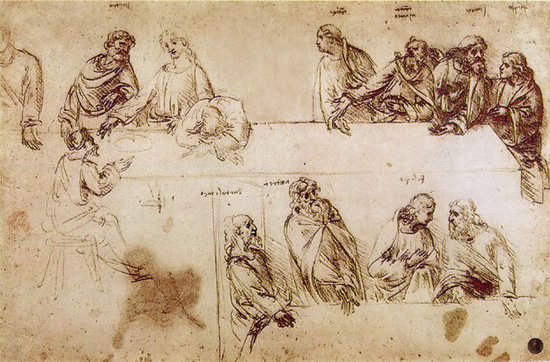 ③An image of two people packed into an empty space.
From the right, Simon, Thaddeus, Matthew, and Philip are completed.
Next, move Thomas, who was standing next to Peter, into the empty space between Philip and John.
That image is the one below.
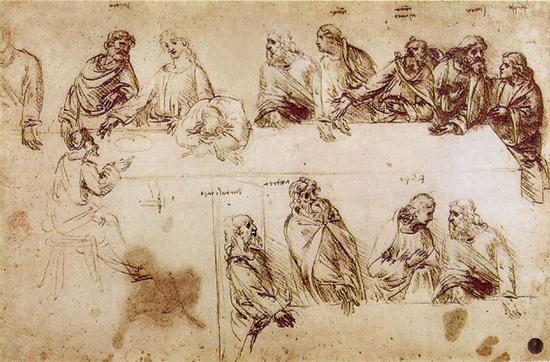 ④ Image with Thomas moved.
At this point, Thomas is not in a pointing pose. However, based on the depiction of his left hand on the table and the posture of his body, there is no doubt that this person was Thomas.
This completes Simon, Thaddaeus, Matthew, Philip, and Thomas from the right.
Furthermore, the image below is a consideration of the left side of the screen.
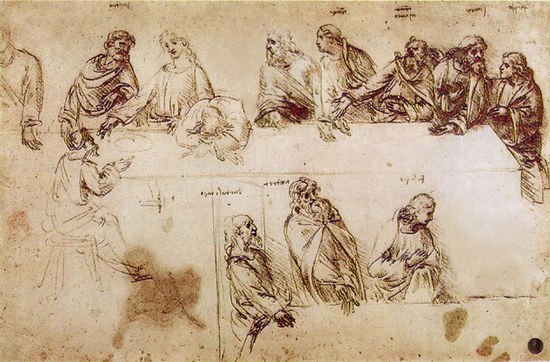 ⑤ Image with Thomas removed from the left group.
Since Thomas was moved to the group on the right side of the screen, the third person from the left of the screen will have no one to talk to.
So Leonardo switches the order of the second person from the left and the third person from the left.
That image is the one below.
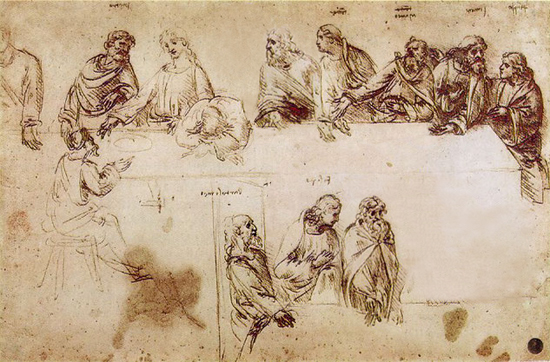 ⑥An image with the order of Andrew and Jacob the Lesser swapped.
From the left, Bartholomew, James the Lesser, and Andrew are completed.
You can see that the reason why the order of James the Lesser and Andrew was switched in this way was because Thomas was moved from the group on the left to the group on the right.
At this point, the layout of the characters excluding the four people in the center and Jacob the Great is completed.
As mentioned above, you can reproduce the poses and combinations of the eight apostles from this trivial drawing.
Composition of the holy trinity
The image below is a reproduction of the central scene of the Last Supper, with Jesus in the center, John on the right, and Peter on the left. Although it is completely different from the composition seen today in the Last Supper, I believe that it is very likely that the Last Supper was originally depicted in this composition.
There are two reasons why I think so. First, as can be seen from the drawing of the Last Supper that Leonardo had prepared, Leonardo initially wanted to depict the Last Supper using the traditional composition, with Jesus in the center and John and Peter on either side. One point is that it is clear that he meant it, and the other point is in the unnatural depiction that can be seen in the current Last Supper.
What is unnatural is John's posture. John's posture is unnaturally tilted. There is no need to tilt the body this far in normal depictions, and there is clearly a trace of some kind of intentional leaning.
Yet another unnatural depiction is the direction of Jesus' face. I find it unnatural that Jesus' face is turned slightly to the right. Why aren't you facing forward? I wonder why there is a need for Jesus to tilt his face.
The image below is one answer to these questions and unnaturalness. My answer is that this may have been the Last Supper that Leonardo originally intended to paint.
 Peter's left hand is about to rest on Jesus' arm in the drawing for the Last Supper prepared by Leonardo.
In addition, the relationship between the bread offered by Jesus and the position of Judas's hand should have been as shown in the diagram on the left, but in the current Last Supper, the distance between Jesus' hand and Judas's hand is too far apart.
This leads me to believe that Judas was also moved from his original location.
In the image above, a pyramid-shaped triangle is placed in the center of the screen, and three people are placed within it. The postures of John and Peter are tilted significantly to fit them into the triangular composition. It seems that Leonardo's original attempt was to use the three people in this triangle to represent God, Jesus the Son, and John the Holy Spirit, alluding to the Holy Trinity.
The reason why John's body is leaning so far is because he is leaning on Jesus, and the reason why Jesus' face is slightly tilted is because he cares for John. A short-tempered Peter approaches Jesus and asks, ``Who is the traitor?'' This kind of composition is often seen in traditional Last Suppers, and it is thought that Leonardo also painted the Last Supper according to such a traditional composition.
In this way, it seems that Leonardo was trying to represent the Holy Trinity by using a triangular composition at the center of the Last Supper.
However, Leonardo discarded this Holy Trinity composition.
Annulment of the Holy Trinity
I believe that the reason Leonardo discarded the composition of the Holy Trinity was because he prioritized the overall balance of the screen.
The image below is a composition of a drawing of the Last Supper that is connected to the end without turning back in the middle. In the image, the distances from Jesus to Simon and Bartholomew at both ends are the same.
In the case of this composition where Jesus is placed in the center of the screen, the number of apostles is twelve, so if Judas is excluded from the front of the table, the number on the left and right will be five and six, which will necessarily be unequal. As a result, the balance of the screen differs between the left and right sides, making it impossible to achieve perfect left-right symmetry.
When painters before Leonardo painted the Last Supper, this left-right imbalance was resolved by shifting the position of Jesus from the center of the painting, but in Leonardo's case, the composition of the entire painting was created using single-point perspective. The emphasized composition makes it difficult to keep Jesus in the center of the picture.
The only way to place Jesus in the center of the screen and to make the screen even on both sides is to add Judas to the group on the other side of the table.
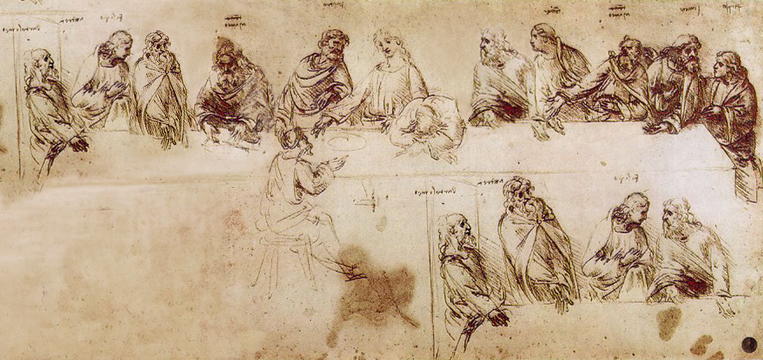
So Leonardo places Judas on the other side of the table, but the next problem occurs.
In order for Judas to receive the bread that Jesus offers, Judas must be moved closer to Jesus. This creates too much space behind Judas, making it impossible to express the left and right sides of the screen evenly.
It seems that Leonardo was very concerned about how to handle the space around Judas.
Since the mission must be completed with a limited number of 12 apostles, it is not possible to increase the number of apostles. The solution Leonardo used was to move the apostles he had already drawn to the area around Judah.
In the end, Leonardo discards the composition of the Holy Trinity and moves John and Peter to the vicinity of Judah.
This led to the evolution of Leonardo's Last Supper into a unique and innovative composition.
In this way, it turns out that the composition of The Last Supper was not completed from the beginning, but was completed by changing the composition many times while drawing and repeating trial and error.
 Leonardo also painted head studies for Bartholomew, Judas, Philip, and Simon, all of which are approximately the same size, measuring 19cm x 15cm.
However, this study of Jacob the Great's head is slightly larger, measuring 25.2cm x 17.2cm.
In addition, while the other head studies of the apostles have a high degree of perfection with extremely detailed details, this study of the head of Jacob the Great has some rough edges.
Due to these differences in characteristics, it is possible that this study of the head of Jacob the Great was painted at a different time from the other head studies.
As for when exactly it was drawn, I think it was probably around the time of the image below, when it became necessary to balance the left and right sides of the screen after placing Judas on the other side of the table.
At this timing, John is drawn on the left side of James the Great, and it is no wonder that the right hand and the area below the chest, which are not drawn in the sketch on the left, are hidden by John, so it is no surprise that they are omitted. is.
After this, the need arises to fill in the blanks after moving John next to Judas, and Leonardo changes the pose of James the Greater to one with his arms wide open.
This is thought to be the reason why the pose of Jacob the Great's drawing is different from the pose of the current mural.
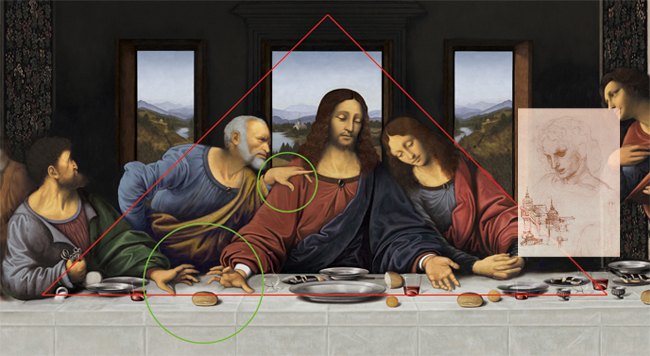
If John and Peter are placed around Judas in the image above, John's hands will overlap with the hands of Jesus and Judas.
In order to avoid this interference, Judas will be shifted to the left. This is the reason for the unnatural distance that we see today between Judas and Jesus (the distance where Judas cannot reach the bread that Jesus offers him).
As mentioned above, the fact that the composition of the Holy Trinity was discarded has a lot to do with the various unnatural depictions seen in the Last Supper today.

leonardoresearch.jp